

Lower EOR cost starts with understanding the delivery model
EOR costs in Vietnam can often be reduced without reducing service quality. The key is not simply negotiating the monthly fee; it is understanding what that fee actually pays for.
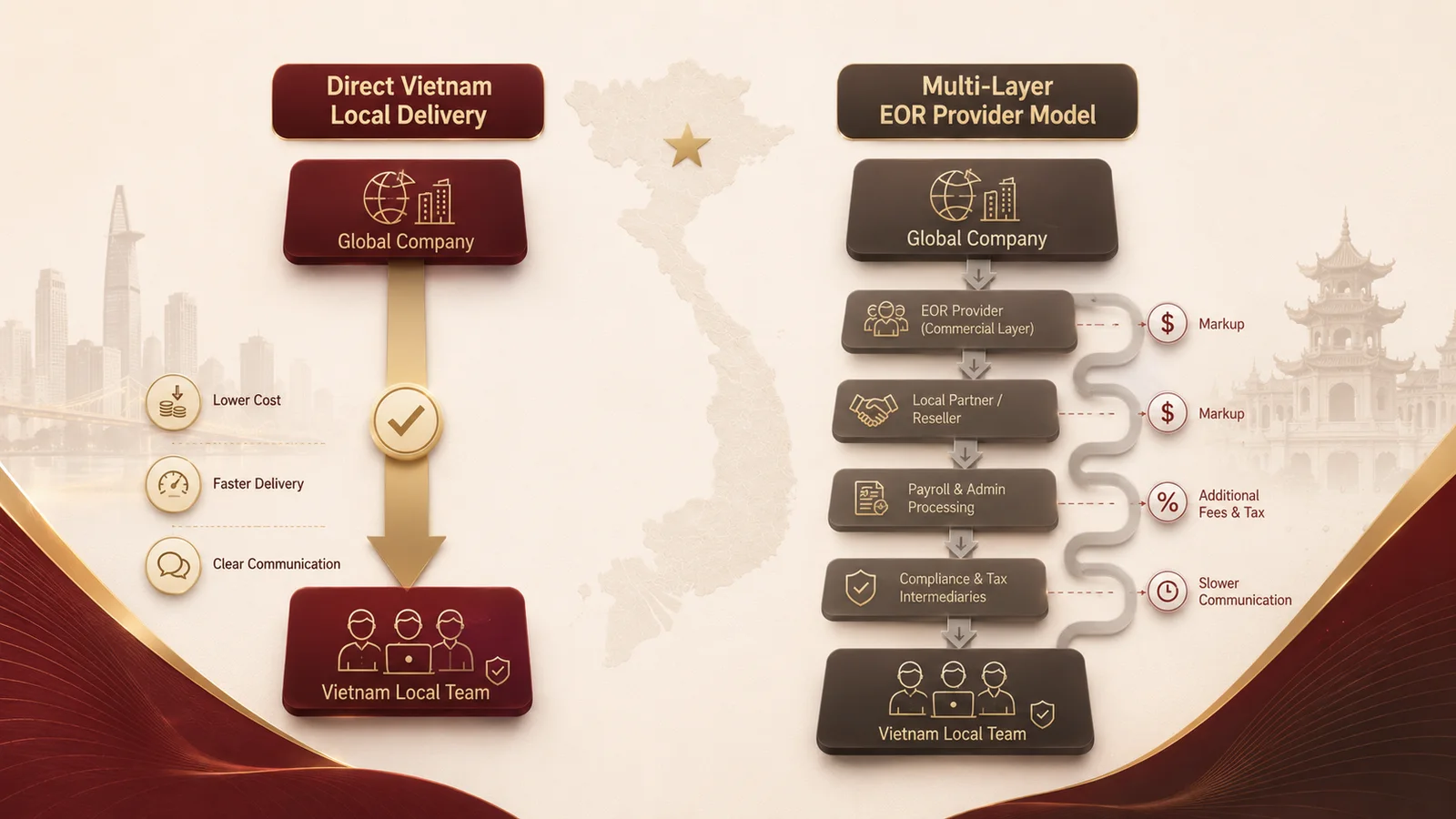
In some EOR arrangements, the provider named in the service agreement is not the party delivering the Vietnam service on the ground. A global or regional provider may sell "Vietnam EOR" under its own brand, while a Vietnam-based local partner carries out the actual local employment, payroll, HR administration and compliance work behind the scenes.
That structure may affect fees, tax treatment and communication. Review the work each party performs, the value of any regional coordination and the route to the local specialist before comparing total costs.
Ask which party delivers each activity and how delivery and coordination appear in the agreed fee.
Step 1: Check who actually delivers the service, and what you are paying for
A company may sign with a global or regional EOR provider that has no Vietnam entity, payroll team or compliance team of its own. To deliver the service, that provider engages a Vietnam-based local partner to do the actual work: employing the worker, running payroll, handling statutory insurance, PIT, HR records, onboarding/offboarding and compliance questions.
In that structure, the client effectively pays for two layers: the Vietnam-based local partner doing the work, and the global or regional provider adding its own margin on top.
As an illustrative scenario, a global or regional provider charges US$700 per EOR employee per month, while the Vietnam-based local partner doing the work charges US$250. For a 10-person team, that gap equals US$4,500 per month, or US$54,000 per year.
This hypothetical difference is a prompt to compare scope. Regional coordination, reporting and other included services may explain part of the price; a direct delivery arrangement may reduce fees if the required outputs and responsibilities are comparable.
Step 2: Compare the full invoice, not just the service fee
Service fee markup is only one part of the cost gap. The full invoice can become even higher once VAT, GST and other indirect tax treatment are considered.
As an illustrative scenario, assume a US$2,000 monthly payroll cost. A direct Vietnam local partner invoices under Vietnam VAT rules, where 8% VAT applies. A global or regional provider may invoice from another jurisdiction, where VAT/GST can be higher, for example 10%.
Additional cost under the global/regional provider model: US$716 per employee per month, or US$8,592 per employee per year.
The figures below are hypothetical assumptions, not a market benchmark or a provider quotation. Actual pricing and tax treatment depend on the provider, invoice structure, employee profile, insurer, exchange rate policy and agreed service scope.
| Cost item | Direct Vietnam local partner | Global / regional provider model |
|---|---|---|
| Service fee | US$250 | US$700 |
| Monthly payroll cost | US$2,000 | US$2,000 |
| Embedded local tax component | n/a | US$160 (= US$2,000 × 8% VAT) |
| Subtotal before final tax | US$2,250 | US$2,860 |
| VAT / GST / indirect tax | US$180 (= US$2,250 × 8% VAT) | US$286 (= US$2,860 × 10% GST) |
| Total monthly bill | US$2,430 | US$3,146 |
Takeaway: In this illustrative scenario, the client is not only paying a higher service fee. They may also be paying indirect tax on a higher invoice amount. As payroll cost and headcount increase, this "tax-on-markup" effect becomes more material.
Buyers should check who issues the invoice, which VAT/GST is being charged, and whether that tax is actually recoverable. In a multi-layer structure, tax can be charged on top of a higher invoice amount, and if it cannot be recovered, it becomes a real additional cost.
The 8% rate in this scenario reflects Vietnam's temporary VAT reduction under Resolution 204/2025/QH15, which applies to eligible goods and services, with exclusions. Confirm the treatment of a specific invoice with the invoicing provider and, where needed, an appropriately qualified adviser.
Step 3: Check whether the delivery model slows response time and handover
A payroll question or compliance query may pass through an account manager and a local delivery partner. Additional handoffs can affect response time or context, depending on how the provider organizes communication and supervision.
Before signing, confirm who handles technical questions, who reviews the work and how urgent payroll matters reach the responsible specialist. Agree response expectations and an escalation route.
For an account handover, ask how the provider retains payroll history, employee records, prior approvals and open requests. A written action list and named responsibilities help the next contact continue the work without asking the client to reconstruct the history.
Questions to ask before signing with an EOR provider
- Do you have your own Vietnam entity, or are you relying on the provider to be the legal employer?
- Who is the actual employer of record, and who runs payroll and statutory submissions?
- Who answers labour-law and compliance questions directly?
- What's included in the monthly fee, and what does the full invoice look like, including tax treatment?
- What's the expected response time, and how is client history maintained if your account manager changes?
How Truzand can help
Truzand is a Vietnam-based provider of expert-led HR consulting and managed services: Outsourced Payroll Services, EOR (Employer of Record) and HR Compliance & Setup. Experienced professionals support the agreed payroll, PIT, statutory-insurance and employment processes, with technology used for coordination and records. Clients have direct support, defined deliverables and a scope and fee structure agreed before work begins. Under EOR (Employer of Record), the client directs daily work, performance and business priorities.
Truzand can help you review the proposed service scope and fee breakdown against your entity status, headcount and operating model. Any cost difference depends on the actual engagement and comparable outputs. You can also estimate the monthly employer cost of a Vietnam hire first.
Share your current headcount, entity status and, where you have one, your existing EOR quote or invoice, and Truzand will walk through where the cost difference is coming from, with no obligation.
Talk to TruzandRelated reading: Hidden Fees in EOR/PEO Vietnam: 4 Pricing Gaps to Check Before Signing. The four pricing gaps that quietly inflate EOR and PEO costs in Vietnam, and what to confirm with a provider before you sign.
What this does not cover
Figures in this article are illustrative. Actual costs depend on the provider, the employee's circumstances, the insurer, exchange rate policy and the agreed service scope. Tax treatment should be confirmed with an appropriately qualified adviser.