

Understanding Vietnam's additional payment obligation for foreign employees and its implications for severance liability.
A Small Payroll Item. A Potentially Significant Financial Liability.
When employing foreign professionals in Vietnam, international businesses often focus on the more visible aspects of employment compliance: work permits, employment contracts, compulsory social insurance and monthly payroll administration.
However, there is another payroll obligation that can easily be overlooked: the additional payment equivalent to the employer's unemployment insurance contribution for foreign employees who are not covered by compulsory unemployment insurance.
Although this payment represents just 1% of the applicable salary, its implications extend beyond monthly payroll costs.
Under Vietnam's Labour Code, the payment is linked to the determination of an employee's eligible service period for severance allowance purposes. When an employer fails to fulfil this obligation, the corresponding employment period remains included in the calculation of severance allowance upon termination.
Key takeaway: The issue is not simply whether an additional 1% should appear on a payslip. It is whether the employer has properly managed an employment obligation that can affect its financial liabilities years later.
1. Understanding the 1% Additional Payment Obligation
1.1. Foreign employees are excluded from unemployment insurance
Under Article 31 of the Law on Employment 2025 (Law No. 74/2025/QH15), foreign employees working in Vietnam are not included in the compulsory unemployment insurance scheme.
Unlike eligible Vietnamese employees, foreign employees do not participate in the unemployment insurance system through monthly contributions to the Unemployment Insurance Fund. However, exclusion from compulsory unemployment insurance does not mean that employers are automatically relieved of all related financial obligations.
1.2. The employer's obligation under Article 168.3 of the Labour Code
Article 168.3 of the Labour Code 2019 establishes an additional payment obligation. Where employees are not subject to compulsory social insurance, health insurance and unemployment insurance, employers must pay them, together with their regular salary, an additional amount equivalent to the employer's statutory insurance contributions.
For foreign employees, the applicable payment depends on their compulsory social insurance status.
| Employee's status | Social Insurance (SI) | Health Insurance (HI) | Unemployment Insurance | Additional Amount Payable by Employer with Salary |
|---|---|---|---|---|
| Foreign employee signing a fixed-term employment contract of at least 12 months | Employer contributes 17.5% | Employer contributes 3% | Not subject to contribution | 1% |
| Foreign employee who has reached retirement age at the time the employment contract is concluded | Not subject to contribution | Not subject to contribution | Not subject to contribution | 21.5% |
1.3. How is the 1% calculated?
The applicable rate for the employer's unemployment insurance contribution is 1%. However, the calculation should not be based automatically on the employee's entire gross monthly salary.
Under Article 34 of the Law on Employment 2025, the salary used as the basis for unemployment insurance contributions includes:
- Salary based on the employee's job or position.
- Salary allowances.
- Other additional amounts agreed upon in the employment contract and paid regularly and consistently in each salary period, subject to statutory conditions.
The applicable contribution base is also subject to a statutory ceiling of 20 times the regional monthly minimum wage.
2. The Connection Between the 1% Payment and Severance Allowance
2.1. Foreign employees are still entitled to severance allowance
Under Article 46 of the Labour Code 2019, employees who have worked regularly for an employer for at least 12 months may be entitled to severance allowance when their employment contracts terminate under qualifying circumstances.
The entitlement applies to the termination circumstances specified in Clauses 1, 2, 3, 4, 6, 7, 9 and 10 of Article 34, subject to statutory exceptions.
The severance allowance is calculated at half a month's salary for each year of eligible service. The salary used for the calculation is the average salary under the employment contract for the 6 months immediately preceding termination.
2.2. How does the additional 1% payment reduce severance exposure?
The relationship between the additional 1% payment and severance allowance is explicitly addressed under Point b, Clause 3, Article 8 of Decree No. 145/2020/ND-CP.
Under this provision, the period during which an employee is not required to participate in compulsory unemployment insurance but receives an additional payment from the employer, equivalent to the employer's unemployment insurance contribution and paid together with their salary, is treated as a period of unemployment insurance participation when calculating severance allowance.
In practical terms:
- Where the additional payment is made: The corresponding employment period is treated as a period of unemployment insurance participation and is therefore excluded from the service period used to calculate severance allowance.
- Where the additional payment is not made: The corresponding employment period remains included in the service period used to calculate severance allowance, subject to the applicable statutory conditions.
This means that the 1% payment is not only a monthly payroll obligation. It also determines how the corresponding employment period is treated when calculating the employer's severance liability upon termination.
For employers, maintaining accurate payroll records and evidence of these payments is therefore essential. It helps demonstrate compliance with statutory obligations and provides a clear basis for determining the employee's eligible service period when employment ends.
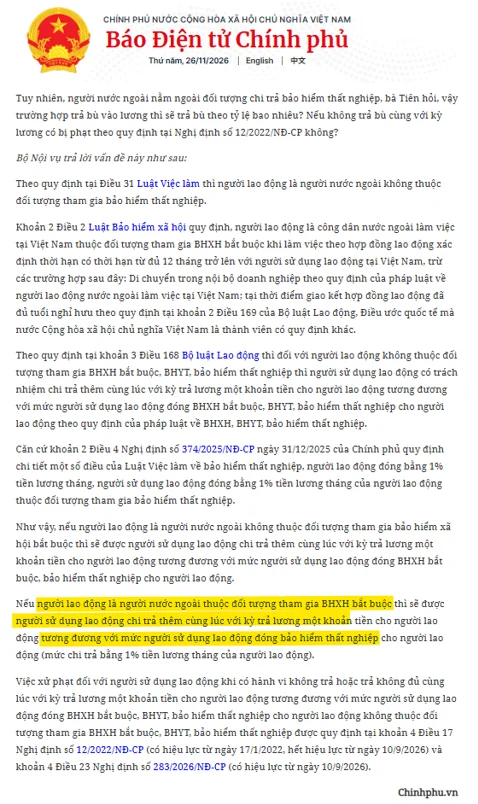
The Ministry of Home Affairs has also provided official clarification on the application of this provision to foreign employees, reinforcing the importance of making the additional payment in accordance with Vietnam's labour regulations.
2.3. A practical illustration: The cost of overlooking the 1%
Consider a company employing a foreign professional in Vietnam under a qualifying employment arrangement.
| Employment details | Assumption |
|---|---|
| Actual Period of Service | 5 years |
| Average monthly contractual salary during the final 6 months | VND 100,000,000 |
| Eligible service period for severance calculation | 5 years |
| Additional 1% payment | Not made throughout the 5-year period |
Assuming all 5 years qualify for severance calculation and the employee's termination falls within Article 46, the potential severance liability would be:
Potential severance liability
VND 100,000,000 × 0.5 × 5 years
= VND 250,000,000
For comparison, assuming an applicable unemployment insurance salary base of VND 100 million throughout the 5 years, the equivalent 1% payment would total:
Equivalent 1% payment over 5 years
VND 100,000,000 × 1% × 12 months × 5 years
= VND 60,000,000
2.4. How the severance pay changes with salary and service duration
The following table illustrates how an employer's potential severance allowance liability increases with the employee's salary and eligible years of service.
| Average monthly salary for severance calculation | 3 eligible years | 5 eligible years | 10 eligible years |
|---|---|---|---|
| VND 50M | VND 75M | VND 125M | VND 250M |
| VND 100M | VND 150M | VND 250M | VND 500M |
| VND 150M | VND 225M | VND 375M | VND 750M |
For employers, overlooking the additional 1% payment means a longer service period being counted towards severance allowance, resulting in substantial liabilities when terminating the employment of highly compensated expatriates.
3. Common Payroll Compliance Gaps Among Foreign Employers
In practice, the issue is not necessarily a deliberate decision to disregard employment regulations. It often arises from gaps between payroll administration, HR operations and finance oversight.
3.1. Assuming that no unemployment insurance means no additional payment
A common misunderstanding is that because foreign employees are excluded from compulsory unemployment insurance, employers do not need to account for any related payment. This overlooks the separate obligation under Article 168.3 of the Labour Code. The distinction between contributing to an insurance fund and paying an equivalent amount directly to an employee is fundamental.
3.2. Failing to make the payment together with monthly salary
Article 168.3 requires the additional amount to be paid together with the employee's salary. Treating this obligation as an occasional year-end adjustment or waiting until the employee leaves the company does not reflect the prescribed payment arrangement. Employers should ensure that the amount is incorporated into the regular payroll cycle and supported by appropriate payment records.
3.3. Disconnecting employment contracts from payroll implementation
Employment contracts, payroll calculations and actual payments should be consistent. Simply including a clause stating that the employee is entitled to an additional payment does not, by itself, establish that the employer has fulfilled the obligation. Companies should retain supporting evidence showing that the amount was correctly calculated and actually paid together with the relevant salary payments.
4. What Should Employers Do? A Practical Compliance Framework
For businesses employing foreign professionals in Vietnam, the following measures can help identify and manage potential compliance gaps.
01. Review employee insurance eligibility
Determine whether each foreign employee is subject to compulsory social insurance in Vietnam, taking into account employment arrangements, contract duration and applicable statutory exclusions.
02. Verify the applicable salary base
Identify the salary components used to determine the unemployment insurance contribution base and apply the relevant statutory ceiling.
03. Validate the additional payment
Check whether the employer's equivalent 1% payment has been correctly calculated for employees subject to compulsory social insurance but excluded from unemployment insurance.
04. Review monthly payroll records
Verify that the payment is made directly to the employee together with regular salary and that the payroll records adequately reflect the transaction.
05. Assess historical compliance
Review previous employment periods, payroll records and payment evidence to identify potential gaps.
06. Evaluate severance exposure
Assess the employee's actual service period, periods treated as unemployment insurance participation, prior severance payments and applicable termination conditions.
07. Establish ongoing monitoring
Integrate the obligation into the company's payroll procedures and employee onboarding process.
What if the company has already missed previous payments?
Employers should not assume that historical underpayments can simply be corrected through a lump-sum payment when an employee leaves. Under Article 168.3 of the Labour Code, the additional payment must be made together with the employee's regular salary. Point b, Clause 3, Article 8 of Decree No. 145/2020/ND-CP similarly requires the equivalent payment to be made together with salary for the corresponding period.
Accordingly, a retrospective lump-sum payment should not automatically be treated as satisfying the statutory condition for excluding previously unpaid service periods from severance allowance calculations. Where the required payments were not made together with the relevant salary payments, employers may remain liable for severance allowance attributable to those periods, subject to the statutory eligibility and calculation rules.
Employers should therefore review historical payroll records, identify outstanding payment obligations and assess potential severance liabilities rather than relying on a last-minute lump-sum payment to eliminate them.
5. How Truzand Helps International Businesses Manage Employment Compliance in Vietnam
At Truzand, we understand that employing people in Vietnam involves more than simply issuing employment contracts and processing monthly salaries. International employers need a local partner who understands the interaction between Vietnamese employment regulations, statutory insurance requirements, payroll administration and employment-related financial liabilities.
Outsourced Payroll Services
Monthly payroll processing, statutory insurance calculations, personal income tax administration and payroll compliance monitoring, depending on the agreed scope.
Employer of Record (EOR)
Supporting the local employment and HR administration of your talent in Vietnam without requiring your company to establish a local legal entity, while your company continues to manage their daily work.
Managing employees in Vietnam? Let's get compliance right from day one. Whether you are hiring your first employee in Vietnam or managing an established local workforce, Truzand helps you navigate local employment requirements with greater clarity and control.
Contact Truzand6. Legal References & Further Reading
The following legislation and official guidance form the legal basis for this insight.
- Labour Code 2019 – Law No. 45/2019/QH14: Article 46 (Severance allowance) and Article 168.3 (Additional payment obligation).
- Law on Employment 2025 – Law No. 74/2025/QH15: Article 31 (Unemployment insurance eligibility) and Article 34 (Salary basis for unemployment insurance contributions).
- Decree No. 374/2025/ND-CP: Detailed regulations on unemployment insurance contributions.
- Decree No. 145/2020/ND-CP: Detailed guidance on severance allowance and employment-related matters.
Official Government Guidance
- Ministry of Home Affairs: Severance allowance for foreign employees – Government News Portal, 8 April 2026.
Disclaimer
This article is provided for general informational purposes and does not constitute legal, tax or professional advice. The application of Vietnamese employment and insurance regulations depends on the employee's individual circumstances, contractual arrangements and applicable legislation. Employers should obtain case-specific advice before making employment or payroll decisions. Truzand provides HR consulting, payroll administration, employment administration and compliance support; it is not a law firm, tax agent, accounting firm or audit firm.


